
Evidence requests follow the suspected physical pathway, not a generic attachment checklist.
Semiconductor domain intelligence
Technical depth that changes the next action.
CMP, patterning, and advanced packaging do not fail the same way. FabQED™ brings domain-specific mechanisms, evidence, containment logic, and communication boundaries into the response from the first customer signal.
Customer signalMechanismEvidenceContainmentDecisionSigned proof
Start with the context that can separate one cause from another.
Select a domain to see how FabQED™ reshapes the evidence ask, causal boundary, investigation path, and customer-safe response.
Domain response lens
Read the surface as a coupled chemistry-mechanics system.
CMP excursions sit at the intersection of slurry chemistry, pad and conditioner state, film stack, polisher history, endpoint behavior, and the post-CMP clean route.
- Bind first
- wafer signature to tool, head, pad, conditioner, slurry, and clean-route genealogy
- Separate
- incoming material variation from consumable state, polisher state, and clean-path effects
- Prove with
- defect map, SEM/EDS, process trace, pad age, slurry data, and known-good splits
Excursion signals
- scratch morphology
- residue or corrosion
- dishing and erosion
- removal-rate drift
Response decisions
- bound exposed lots
- rank physical pathways
- select the next evidence test
- hold customer claims to proof
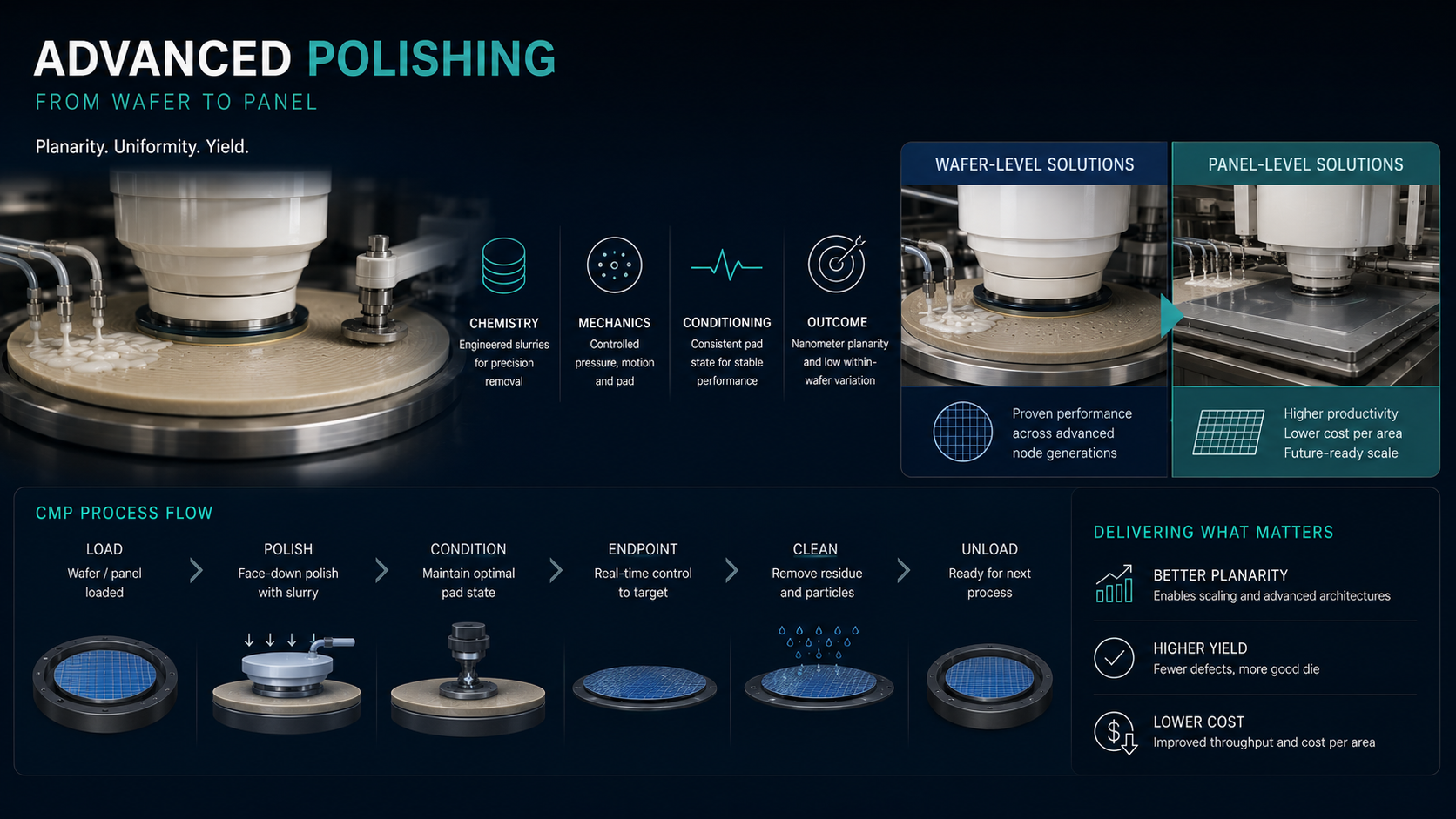
ConsumablesPolisher stateFilm stackPost-CMP clean
Domain knowledge is useful when it improves the response.
Containment follows material, lot, tool, interface, route, and customer exposure.
Owners and due work change with the mechanism, proof gap, business risk, and response stage.
Customer updates remain clear about what is known, what is being tested, and what is approved.
Semiconductor Atlas + complaint-to-closure
The concept map supplies context. The operating record turns it into accountable work.
Semiconductor Atlas connects device, process, material, package, equipment, and reliability concepts. FabQED™ applies that context to evidence decisions, owner handoffs, customer commitments, and proof of closure without exposing the underlying knowledge substrate.
Semiconductor context
Evidence-backed response
See the depth in motion
Request a pilot